
Driveway Sealcoating
Two thin coats of sealer over a cleaned, crack-filled home driveway, timed for the stretch of the year when Des Moines nights stay above 50 degrees.
Typical: $282 - $868 for a typical drive; $0.88 - $2.10 per sq ft installed
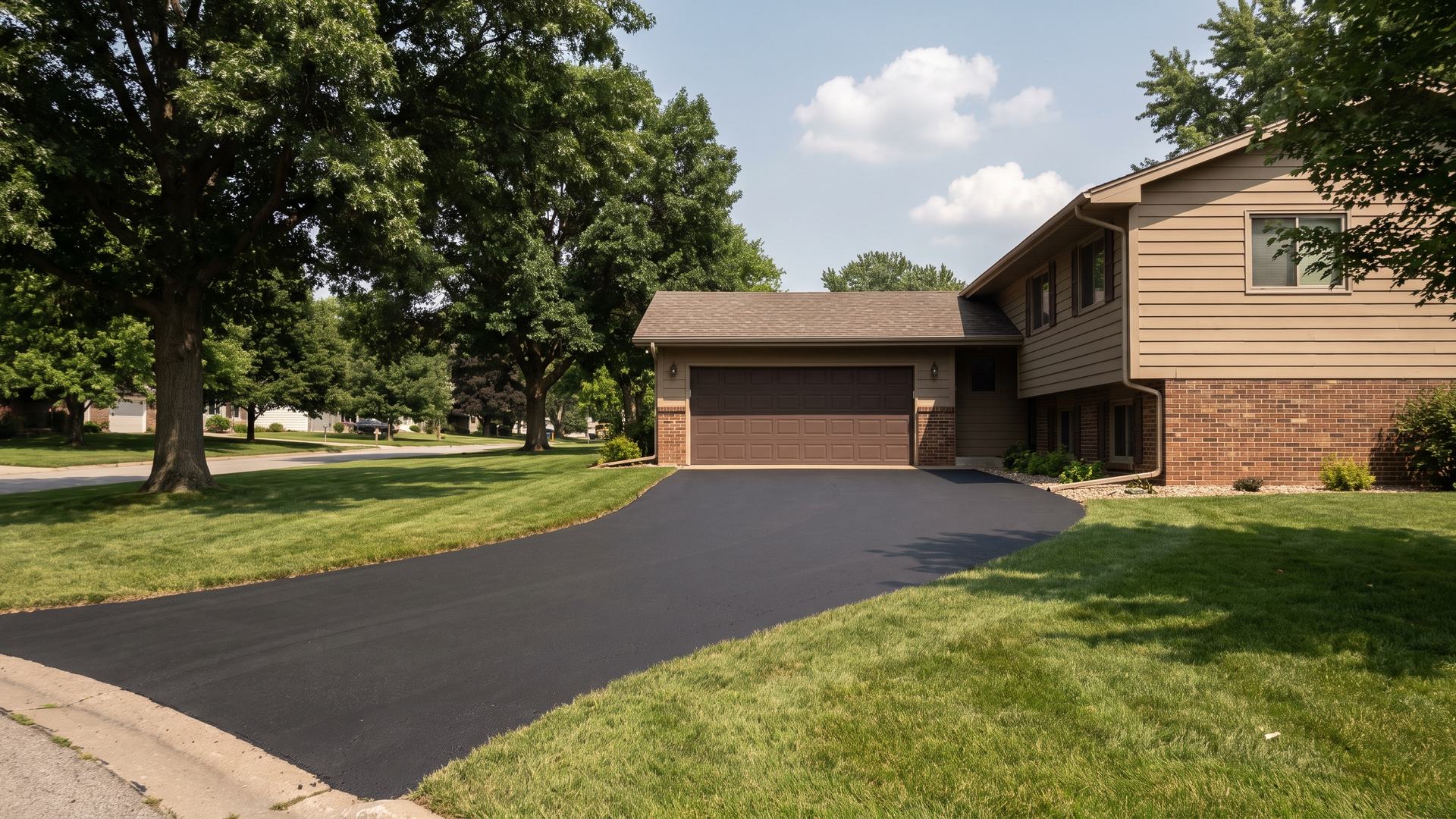
Air at the Des Moines airport weather station crosses the freezing line about 80 days a year, and the glacial till under local driveways stays wet from March into June. Here is what sealing does about that, and what it costs.
The last glacier to reach Iowa stopped here. The Iowa Geological Survey dates the Des Moines Lobe's first surges to about 15,000 years ago and places its southern limit, reached around 14,000 years ago, at the site of the modern city. It left 45 to 60 feet of dense, pebbly drift and a flat landscape with sluggish drainage, where dark low spots still mark ground that once held standing water. That inheritance decides how asphalt ages in Polk County. Pavement here spends much of the year resting on damp soil, and damp soil is what turns a hard freeze into heaving, cracking and potholes.
Seal coating is one of the least expensive treatments in the pavement toolbox. SealMaster, a large sealer manufacturer, puts it at under a tenth of the price of an asphalt overlay. It is also one of the most misunderstood. A coat of sealer slows the oxidation that turns black asphalt gray and brittle, and it lets rain and meltwater run off instead of soaking in. It cannot dry out a saturated base or hold together pavement that has broken into small plates. The pages on this site sort those cases out: when driveway sealing is the right call, when crack filling has to come first, and when a sunken or soft section needs patching or replacement.
This is a referral site, not a paving company. It publishes observed price ranges on the cost page, explains each service in plain terms, and passes quote requests to independent contractors who work across the metro. Nobody here shows up with a squeegee. The aim is to let a homeowner in Beaverdale or a property manager in Ankeny walk into a bid knowing what the job should include, what the weather has to do that week, and roughly what a fair number looks like.
Free quote
Two thin coats of sealer over a cleaned, crack-filled home driveway, timed for the stretch of the year when Des Moines nights stay above 50 degrees.
Typical: $282 - $868 for a typical drive; $0.88 - $2.10 per sq ft installed

Hot-poured rubberized sealant worked into cleaned cracks, so meltwater stops reaching the damp glacial till under Des Moines driveways and parking lots.
Typical: $1 - $3 per linear ft; most driveways $100 - $400

Saw-cut, full-depth patches and pothole repair for driveways and lots, rebuilt with fresh stone and hot mix where wet Polk County till has let the base fail.
Typical: $100 - $400 per pothole; $4 - $12 per sq ft for saw-cut patches

Two or three coats of sealer on commercial, church and apartment lots, laid in sections around business hours and planned around snow that has to stay on the property.
Typical: $0.10 - $0.50 per sq ft; 10 - 15 car lots about $1,200 - $2,100

Stall lines, arrows and accessible spaces repainted to the 2010 ADA counts and Iowa's own symbol rule, usually the day after a lot is sealed.
Typical: $4 - $20 per stall; 30 - 50 stall lots $500 - $1,200

A written multi-year schedule of crack sealing, patching, sealcoating and restriping for lots and long drives, keyed to the local freeze calendar instead of to failures.
Typical: $0.65 - $0.90 per sq ft per full cycle of seal, cracks and lines

New asphalt driveways, replacements and overlays, built on a compacted stone base suited to wet glacial till, with the permits a new approach or curb cut requires.
Typical: $5 - $15 per sq ft new or replaced; $3 - $7 per sq ft for an overlay
Every timing claim here traces to NOAA's 1991-2020 normals for Des Moines International Airport, station USW00014933: about 80 freeze-thaw days, a median last spring freeze of April 17, a median first fall freeze of October 17, and overnight lows that hold above 50 degrees only from May through September. A contractor's schedule should fit those numbers, and an owner who knows them can spot a start date that is optimistic.
The cost page lists observed ranges from published cost guides and a sealer manufacturer, with the unit or driveway size behind each figure. They are not quotes. They exist so a bid for a two-car drive in Urbandale, or for a 40-stall lot along Merle Hay Road, can be checked against the wider market before anyone signs anything.
On glacial till that carries a seasonal water table from March into June, many driveway failures begin underneath. The pages here say so plainly. When a drive has sunk, holds water for hours or has broken into small interlocking pieces, the advice points to patching, regrading or replacement rather than another coat that would only hide the trouble for a season.
Quote requests go to independent contractors who work in Polk County and the suburbs around it. The site does not do the work and does not pick a winner. Every requester gets the same checklist, so bids can be compared line by line on crack treatment, number of coats, product name and cure time instead of on the total alone.
Gray, rough asphalt with fine surface cracks is a sealing job. Cracks that divide the drive into rectangles are block cracking from aging binder. Tight, interlocking cracks over a soft spot are fatigue cracking, a structural failure no coating can cure. Water that stands for hours marks a depression. Sorting those out first decides whether the work is sealing, crack filling, patching or replacement.
Downspouts and sump lines that empty onto the drive get redirected; the city recommends outlets at least 15 feet from the house and from property lines. Cracks are blown clean and filled with hot-poured rubberized sealant, which sets in about ten minutes. Oil spots are cleaned and primed, and sunken or broken areas are saw-cut and patched.
Sealer needs 50 degrees and rising for 24 hours, with no rain expected for a day afterward. In Des Moines that points to mid-May through mid-September. A sound job is two thin coats on a driveway, with a third coat on the entrances and drive lanes of a busy commercial lot, rather than one heavy pass.
Vehicles stay off for at least 24 hours after the final coat. From then on the job is maintenance: look for new cracks each spring after the March freeze-thaw run, fill them before the first fall freeze, and plan the next coat in two to three years. Parking lots add restriping and an accessibility check whenever the lines are repainted.
The lobe's upland soils include a sequence that soil scientists call the Clarion catena, and its members differ mainly in how much water they hold. USDA series descriptions put Clarion soils on the rises: moderately well drained, yet saturated at four to six feet from March through June. Nicollet soils sit a step lower and can be saturated within a foot and a half of the surface. Webster soils on the broad flats, in their natural undrained state, hold water within the top eight inches in the wettest part of a normal year. Their close neighbor, Okoboji, fills closed depressions and is frequently ponded for long stretches, and that series was established right here in Polk County in 1958. One driveway laid across a gentle rise and a flat can sit on two of these soils.
NOAA's 1991-2020 normals for the Des Moines International Airport station count 124.7 nights a year at or below 32 degrees and 44.2 days when the high never climbs above freezing. The difference, about 80 days, is how often the surface freezes and then thaws in a normal year. December and March tie for the most crossings at 15.5 each, and the March cycles arrive just as Clarion soils enter their March-to-June saturated season. Normal snowfall is 35.3 inches, with 5.2 of it still falling in March. Of the 36.02 inches of total precipitation, roughly seven tenths lands between April and September, and June is the wettest month.
Housing in the city is old. The Census Bureau's 2020-2024 American Community Survey gives a median year built of 1961 and counts 26,067 of the city's 97,604 housing units as built in 1939 or earlier, plus 14,483 from the 1950s alone. The oldest neighborhoods show it in their streets: Carpenter, Drake, Sherman Hill and part of River Bend run odd-even snow parking because, as the city explains, their narrow streets were laid out for horses rather than plow trucks. The suburbs are younger by decades, with median build years of 1992 in Urbandale, 1994 in West Des Moines, 2004 in Johnston and 2006 in Ankeny.
The city looks after 913 miles of roadway, and its own condition assessment rated 43 percent of its streets poor or very poor. Fleur Drive, Hubbell Avenue and a long list of neighborhood streets now sit in a multi-year rebuilding program planned with a 20-year computer model. Winter work starts before the snow. Public Works mixes its own brine from Kansas-mined rock salt and Des Moines Water Works tap water, and 13 trucks spray it ahead of storms. Snow routes are plowed once more than an inch accumulates, and the city says every home lies within four blocks of one. Each driveway apron meets that treated street at the curb.
Several city rules reach the driveway itself. Snow cleared from driveways and parking lots may not be placed on the street or public right-of-way, and a first violation draws an administrative penalty, so the piles stay on private ground and melt where they sit. Sidewalks must be cleared within 48 hours after a snowfall ends. The abutting owner is responsible for the public walk, gets 180 days to repair a defect after notice, and needs a city permit to do it; the city's standard treats a three-quarter-inch vertical separation as a defect, which matters where an asphalt drive meets the walk. On sealer choice, no Iowa city, county or state restriction on coal-tar sealcoat appears on the national ban tally kept by Coal Tar Free America.
Rivers add a second source of water. The Raccoon River meets the Des Moines River downtown, and both have flooded the city within living memory. In 1993 the Raccoon crested at 26.7 feet, 14.7 feet above flood stage, shutting the Fleur Drive treatment plant and leaving residents without water service for 11 days. In 2008 it crested at 24.5 feet at the Fleur Drive plant, 12.5 feet above flood stage. Birdland flooded in both years when the Des Moines River levee was breached, and the Army Corps of Engineers finished rebuilding that levee in November 2011. Lots on low ground near those rivers are one more reason this site treats drainage as the first question on any driveway, ahead of product or price.
These are observed market ranges gathered from national cost guides and a sealer manufacturer, not quotes from Des Moines contractors. None of the guides publishes a Des Moines figure for sealing, so each row below carries the unit or driveway size behind it, and local bids should be read on the same basis: square feet of pavement, linear feet of cracks, number of coats and the prep included. Mobilization is the hidden variable on small jobs. HomeGuide lists a $100 to $250 minimum service fee on asphalt repairs, which is why a single pothole prices far higher per square foot than a whole driveway.
| Service | Typical Des Moines Range |
|---|---|
| Driveway sealcoating, typical residential job | $282 - $868 |
| Driveway sealcoating, installed, per square foot | $0.88 - $2.10 per sq ft |
| Crack filling, hot or cold pour | $1 - $3 per linear ft |
| Pothole fill, one hole with mobilization | $100 - $400 |
National cost guides put a typical professionally sealed driveway at $282 to $868, with Angi's average near $575, and Fixr prices a 20-by-20-foot drive at $355 to $600. None of them publishes a Des Moines figure, and local drives range from short alley pads to long three-car approaches, so square footage matters more than the address. Crack filling, oil-spot priming and a second coat are the usual add-ons. The full price table lists every range with its source and the size behind it.
Sealer makers want 50 degrees and rising for 24 hours and a dry day after application. At the airport station the normal overnight low first clears 50 in May, at 52.2 degrees, holds above it through September at 55.2, then drops to 43.0 in October. The median last spring freeze is April 17, with a one-in-ten chance of a freeze after May 1, and the median first fall freeze is October 17. That makes mid-May to mid-September the dependable window, with a few usable days on either side.
As far as the public record shows, yes. No Iowa jurisdiction appears on the national list of coal-tar sealant bans kept by Coal Tar Free America, while Minnesota has prohibited applying the product statewide since January 1, 2014. The US Geological Survey reports that coal-tar sealcoat typically carries about 1,000 times more PAHs than asphalt-based sealer, and that coal-tar products dominate east of the Continental Divide. An owner who wants an asphalt-emulsion or acrylic product can name it in the request and ask to see it on the bid.
Those are transverse cracks, and Pavement Interactive attributes them mainly to the asphalt shrinking in cold weather as its binder hardens with age. This climate supplies plenty of cold: the airport station averages 11.1 nights a year at or below zero. Each crack then lets water down into till that already holds moisture, and freeze-thaw pries it wider. Filling them with hot-poured rubberized material before winter keeps that water out, and hot-pour crack repair has its own page on materials and timing.
No. A birdbath that holds water for hours is a depression, and Pavement Interactive traces depressions to subgrade settlement from poor compaction. Sealer is a thin coating that follows the shape of whatever lies under it, so the dip stays a dip. On poorly drained Webster or Okoboji soils the fix is usually a saw-cut patch with fresh stone base, or regrading so water leaves the pavement, and only then a coat over the whole drive.
Not into the street. City rules bar placing snow from driveways and parking lots on the street or public right-of-way, and a first violation carries an administrative penalty. That leaves the yard. Piling snow on the downhill side of the drive, and a few feet back from the pavement edge, keeps meltwater from running across the asphalt and refreezing in its cracks during March, when the airport station averages 15.5 freeze-thaw days.
SealMaster calls for 24 hours after the final coat before traffic, and longer is safer in shade or humid weather. Summer heat matters as well. July at the airport station has a normal afternoon high of 85.7 degrees and averages 7.8 days at 90 or above. Warm, fresh sealer stays soft, and a tire turned in place can scuff it down to the stone, so the first drive onto it should be slow and straight.
Not right away. SealMaster says new asphalt should cure for at least 30 to 60 days, and HomeGuide suggests waiting about a year before the first coat, then resealing every two to three years. That question comes up most in the fast-growing suburbs, where the Census Bureau's median year built is 2006 in Ankeny and 2011 in Waukee. The new-build driveway post walks through the first year in detail.
Iowa Code section 364.12 lets a city require the abutting owner to maintain property between the lot line and the curb, and the city points to state law in making owners responsible for the public sidewalk. Any construction there is right-of-way work, which Des Moines Engineering reviews, permits and inspects; the city defines the right-of-way as roads, sidewalks and utilities. Sidewalk permits can be pulled by the owner or the hired contractor through the city's online portal.
SealMaster recommends sealing every three years and warns that regions with harsh winters wear sealer faster; HomeGuide's range runs from two to ten years depending on product and climate. With about 80 freeze-thaw days a year and brined streets at the end of every drive, a Des Moines driveway is more likely to need the short end of that range. The practical test is color and texture: once black has faded to gray and the stones stand proud, the top of the binder has oxidized away.
Square footage, crack footage and where water stands after rain: the form passes those details to independent contractors working in Polk County.
Free quote